






Alexander von Humboldt on stamps!
From Oilbird Caves to Penguin Currents: Alexander von Humboldt on Stamps
How one explorer’s encounters with a cave‑dwelling “oil bird” and a cold ocean current shaped science—and echo today in the stamps that bear his name.
Alexander von Humboldt’s life as an explorer of mountains, caves, and cold seas is written as vividly in postage stamps as it is in any biography. The oilbird and the Humboldt penguin—two strange creatures tied to his name—offer a perfect one‑inch window into his story.
A brief life in motion
Born in Berlin in 1769 to a Prussian noble family, Alexander von Humboldt trained in mining and geology but quickly abandoned a safe bureaucratic career for science in the field.
Between 1799 and 1804 he travelled through today’s Venezuela, Colombia, Ecuador, Peru, Mexico, and Cuba, climbing volcanoes, measuring magnetic fields and temperatures, and recording thousands of plant and animal species.
Back in Europe, Humboldt settled in Paris and then Berlin, publishing the multi‑volume “Personal Narrative” of his travels and, later, “Kosmos,” an ambitious attempt to describe the physical universe as one interlinked whole.
He died in 1859 in Berlin, by then celebrated as one of the most influential scientists of his age; currents, mountain ranges, towns, and animals—not least the oilbird’s cave and the Humboldt penguin—now carry his name.
A cave full of “living lamps”
In 1799, early in that New World journey, Humboldt visited the mission at Caripe in eastern Venezuela and descended into the Cueva del Guácharo.
Inside he encountered thousands of large nocturnal birds whose fat nestlings were rendered into oil; he described them scientifically as *Steatornis caripensis*, the oilbird, and recognised how their life history tied cave, forest, and local people together.
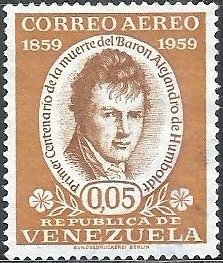
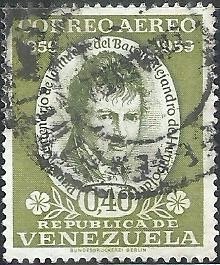
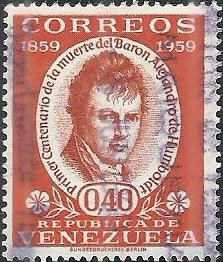
The 1959 Venezuelan centenary set, inscribed “Primer Centenario de la muerte del Barón Alejandro de Humboldt,” places his portrait in a reliquary‑style oval framed by clover‑like ornaments.
For a thematic collector, those frames become stylised cave mouths: tiny altars honouring the man who carried the story of the guácharo—and its dark ecosystem—into global science.
A cold current and a warm‑blooded penguin
A few years later Humboldt’s path led to the Pacific coasts of Peru and Chile, where he lowered thermometers into an unexpectedly cold coastal sea.
His measurements helped define what is now called the Humboldt (Peru) Current, a north‑flowing upwelling of cold, nutrient‑rich water that feeds huge plankton blooms, supports rich fisheries, and helps maintain the arid climate of the Atacama Desert.
That same current sustains *Spheniscus humboldti*, the Humboldt penguin, which nests on rocky coasts of Peru and Chile and hunts in those chilled, food‑rich waters.
The penguin’s name, layered on top of the current’s, shows how an itinerant naturalist who once studied mountains and caves came to be embedded in the language of modern oceanography and ornithology.
The red armchair that links caves and currents
Back in Europe, portrait painters and postal designers fixed Humboldt’s restless life into a single, repeatable image.
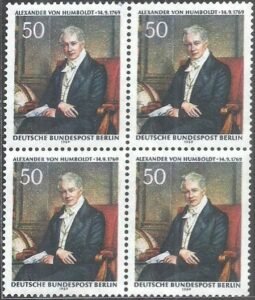
West Berlin’s 1969 50 Pf bicentenary stamp (Scott 9N281) shows him in a deep red armchair with a folded paper in his hand, eyes turned slightly away, based on Joseph Karl Stieler’s famous portrait.
It presents the elderly scholar in a quiet interior, but the dates “1769–1969” and the name “Alexander von Humboldt” carry the memory of jungles, volcanoes, oilbird caves, and ocean soundings into that genteel room.
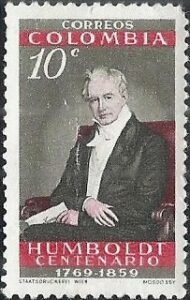
Colombia’s 10 centavos “Humboldt Centenario 1769–1859” issue lifts the same armchair pose and drops it into a vertical frame that shouts “COLOMBIA” and “HUMBOLDT CENTENARIO” in red bands.
Between the oilbird cave in Venezuela and soundings off Peru, many of Humboldt’s key discoveries were made on Latin American soil.
By reusing a Prussian portrait, Colombia and Venezuela appropriate the same face as their own, turning that Berlin armchair into a travelling symbol of their landscapes and scientific identity.
West Berlin: the conversational ecologist
Alongside the 50 Pf, your West Berlin 40 Pf issues offer a lighter, more conversational view.
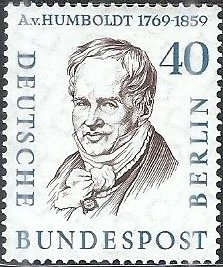
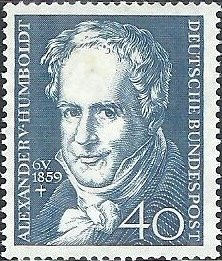
Alexander’s 40 Pf stamp shows a line drawing on a pale field with “DEUTSCHE BUNDESPOST BERLIN” framing the bust, as if someone had sketched him in a lecture notebook while he spoke about mountain vegetation belts or the unity of nature.
The matching 40 Pf for Wilhelm von Humboldt, educational reformer and linguist, pairs the brothers visually: Alexander mapping the planet’s patterns, Wilhelm shaping the modern research university that would nurture future natural scientists.
Together, these West Berlin stamps emphasise a humanist Humboldt—curious, articulate, embedded in institutions yet always pointing back to lived experience in caves, forests, and at sea.
East Germany: lines, data, and the Humboldt‑Universität
East Germany’s designs pick up different threads of the same life.
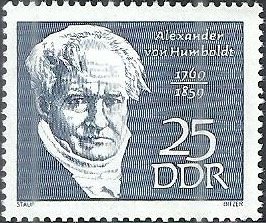
The DDR’s 25 Pf 1969 portrait renders his head as a white profile emerging from dense horizontal lines on a dark ground.
The effect recalls contour maps and isotherm charts—visual tools Humboldt pioneered to show how temperature, altitude, and latitude interact—highlighting the data‑driven side of a man who turned scattered measurements into global patterns.
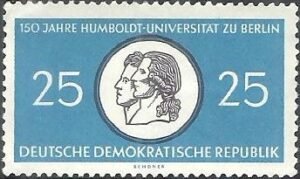
The earlier 25 Pf “150 Jahre Humboldt‑Universität zu Berlin” places Alexander and Wilhelm in a twin profile medallion on a calm blue background.
Here the biography narrows to an institution: the research‑centred Humboldt University in Berlin, whose model of combining teaching and investigation both German states claimed as a prestigious ancestor for their own science systems.
A darker Wilhelm and a louder chorus
Your additional Berlin Wilhelm stamp—darker, more heavily engraved—adds one more biographical brushstroke.
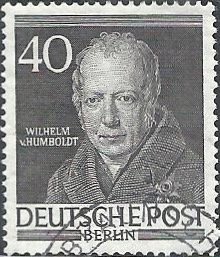
It likely belongs to a definitive series, but in this thematic context it underlines how deeply the Humboldt name is woven into German intellectual life: not just one explorer, but a family network shaping language, education, and research.
And that block of four Berlin 50 Pf stamps?
Multiplied four times, the contemplative armchair scene becomes a visual chorus: four identical Humboldts staring in slightly different directions, like compass points of a single biography—north to Berlin, west to Caracas, south to Callao, east back to the writing desk.
Why oilbird and penguin belong in this story
Seen through the twin triggers of the oilbird and the Humboldt penguin, your eleven stamps turn a concise biography into a layered thematic map.
-
The oilbird cave captures young Humboldt in the field—willing to crawl into darkness, listen to strange echoes, and treat one odd bird as a clue to how ecosystems and local economies fit together—later honoured in Venezuelan centenary issues that frame his portrait like a votive image.
-
The Humboldt Current and its penguin reflect mature Humboldt, turning strings of temperature and position readings into a vision of the Earth as a dynamic system—an aspect echoed in East Germany’s line‑screen portrait and the Humboldt‑Universität medallion.
-
The travelling red armchair, shared across Berlin, Colombia, and Venezuela, freezes the elder scholar yet lets his image migrate between continents, much as his ideas flowed from oilbird caves and Pacific coasts into global science and, eventually, into philately.
For non‑collectors, this is the quiet power of thematic philately: a life of restless travel and ambitious thinking compressed into small rectangles where biography, ecology, and design all intersect.
your “Humboldt animal” on a stamp
If you could design the next Alexander von Humboldt stamp, which creature from his story would you choose as your focal detail—an oilbird bursting out of a cave mouth, a Humboldt penguin surfing an upwelling, or perhaps an electric eel from his Orinoco experiments?
Share your imagined design—or a quick sketch—in the comments on Philapedia:
-
What one tiny visual cue (a cave silhouette, an isotherm curve, a feather pattern) would you use as your personal one‑inch window into Humboldt’s world?
-
And which of your existing stamps feels closest to the Humboldt you admire most: the armchair thinker, the line‑chart systems scientist, or the Latin American “adopted son”?
#AlexanderVonHumboldt #Oilbird #HumboldtPenguin #HumboldtCurrent #ThematicPhilately #VenezuelaStamps #DDRStamps #WestBerlinStamps #LatinAmericaOnStamps #Philapedia